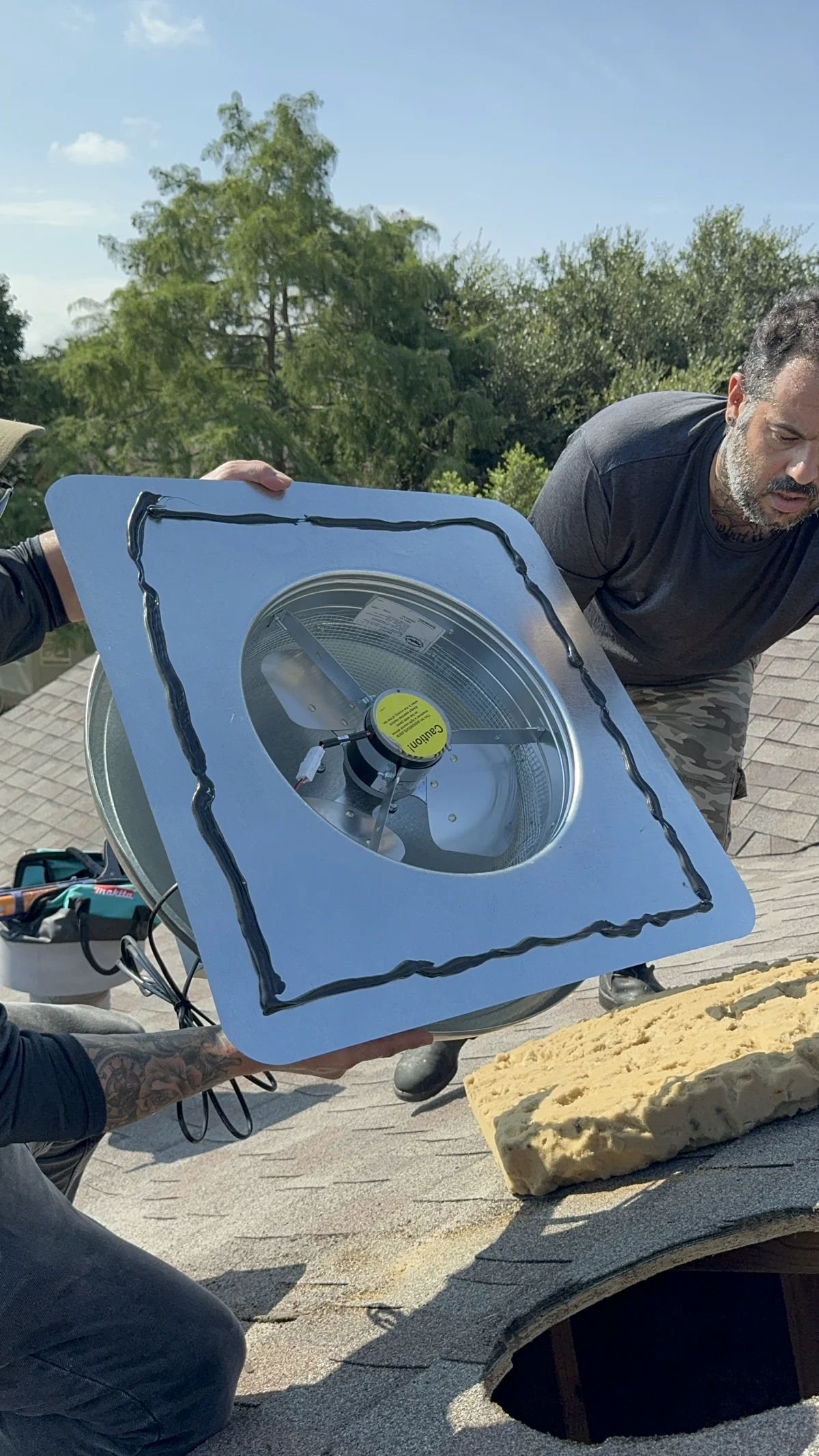
Whole house fans and solar attic fans serve different purposes, and Austin's climate determines which one is the smarter investment. Whole house fans cool your home by pulling outdoor air through open windows and exhausting it through the attic - but Austin's summer nights rarely cool enough for effective use. Solar attic fans exhaust hot attic air to reduce the heat load on your AC system, working hardest on the hottest days when you need them most. For most Austin homeowners, solar attic fans are the better investment because attic temperatures reach 140-150 degrees and make your AC work overtime. Call (512) 601-4451 to discuss solar attic fan installation.
How Whole House Fans Work
A whole house fan is a large fan mounted in your ceiling, usually in a central hallway, that pulls air from inside your home upward into the attic. The positive pressure in the attic forces hot attic air out through the soffit and ridge vents. Meanwhile, you open windows throughout the house, and the fan draws cooler outdoor air in through those windows, creating a powerful cooling breeze throughout every room.
Whole house fans move a massive volume of air - 3,000 to 6,000 cubic feet per minute (CFM) for a typical residential unit, compared to 1,000 to 1,600 CFM for your AC blower. This volume creates a noticeable indoor breeze and can drop indoor temperatures by 5 to 10 degrees within minutes when outdoor conditions are favorable.
The key requirement is that the outdoor air must be cooler than your desired indoor temperature. Whole house fans do not cool air - they replace indoor air with outdoor air. If it is 85 degrees outside at 9 PM, a whole house fan fills your house with 85-degree air. They are most effective in climates where evenings cool into the low 70s or 60s, allowing the fan to flush out the day's accumulated heat and bring in genuinely cool air.
How Solar Attic Fans Work
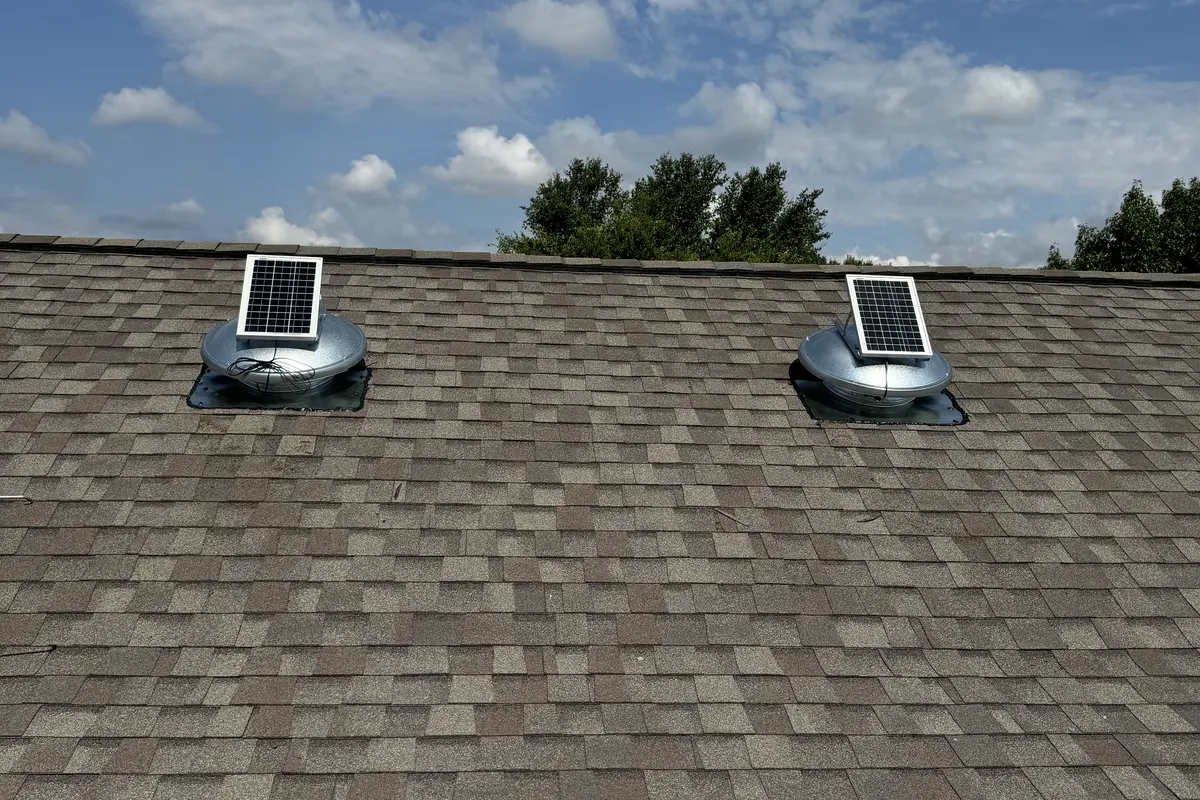
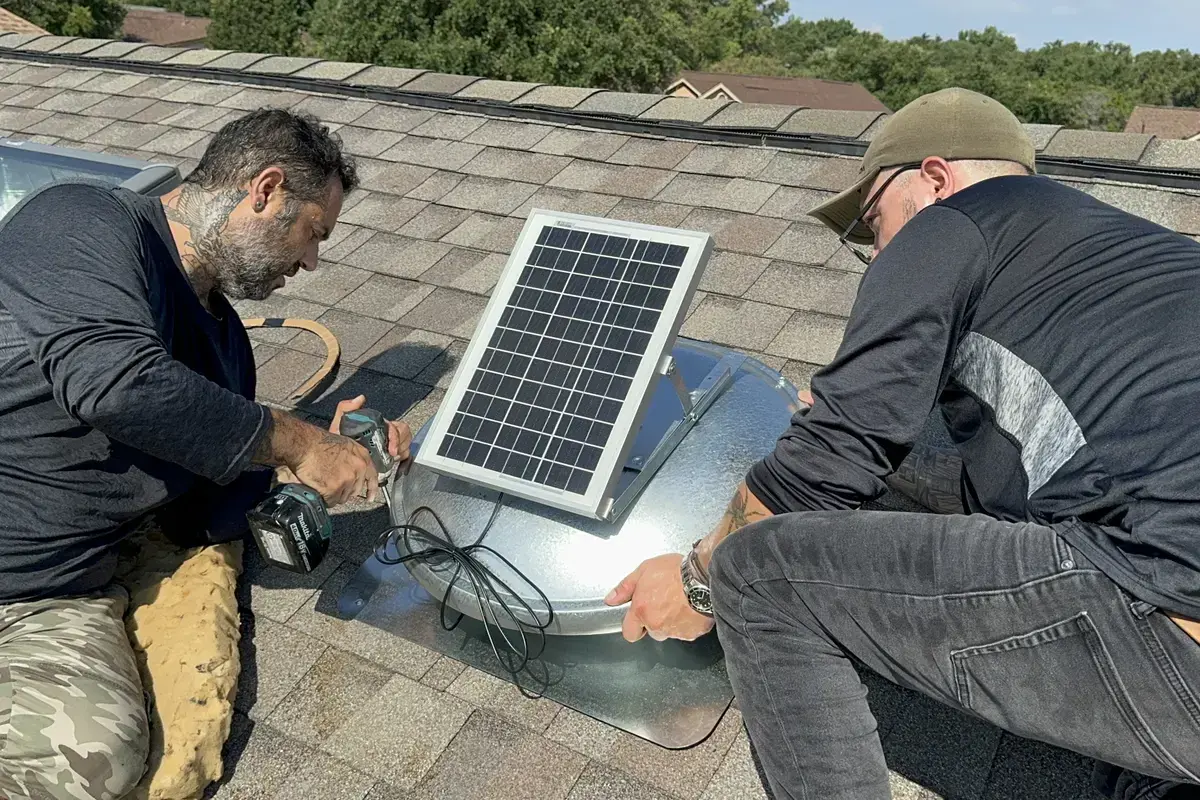
Solar attic fans are smaller, solar-powered exhaust fans mounted on the roof or gable that pull hot air out of the attic space. They do not ventilate your living space directly. Instead, they reduce attic temperature by actively exhausting the superheated air that builds up under your roof during the day.
In a typical Austin home without attic ventilation improvements, attic temperatures reach 140 to 150 degrees on summer afternoons. Your ductwork and air handler sit in this extreme heat, and the heat radiates down through the ceiling into your living space. Your AC runs longer because it is fighting both the outdoor heat and the radiant heat from the attic above.
A solar attic fan draws that 140-degree air out and replaces it with outdoor air (which might be 100 degrees on a hot Austin day, but that is still 40-50 degrees cooler than the unventilated attic). Reducing attic temperature from 150 to 110-120 degrees significantly reduces the heat load on your AC system, lowers the temperature around your ductwork (which reduces duct heat gain), and can extend the life of roofing materials that degrade faster under extreme heat.
Because they are solar-powered, these fans cost nothing to operate. They run automatically when the sun hits the panel - which conveniently is exactly when the attic is hottest and the fan is needed most. No wiring, no electricity cost, no switches to remember.

Why Solar Attic Fans Win in Austin's Climate
The deciding factor in Austin is nighttime temperatures. Whole house fans need outdoor air that is cooler than your indoor comfort zone - typically below 75 degrees - to provide meaningful cooling. Austin's summer nighttime lows tell the story: June averages 72 degrees, July and August average 75 to 76 degrees, and September averages 71 degrees. These are averages - many nights stay above 78 degrees, especially during heat waves that are increasingly common.
That narrow window makes whole house fans unreliable in Austin from June through September, which is exactly when you need cooling the most. You might get 10 to 15 usable nights per month in the shoulder seasons (April-May, October), but during peak summer, you are back on the AC every night. A whole house fan that sits idle for the three hottest months of the year provides limited return on investment.
Solar attic fans, by contrast, work hardest during Austin's worst heat. The hotter the sun, the faster the fan spins and the more hot air it exhausts from your attic. They provide the biggest benefit on the days your AC is working the hardest, reducing the attic heat load precisely when it matters most.
There is also a humidity consideration. Pulling humid Austin outdoor air through your house on summer nights (even if the temperature is borderline acceptable) introduces moisture that your home then has to dehumidify. Running a whole house fan on a 74-degree, 80% humidity night brings in air that feels muggy and can raise indoor humidity levels that take hours of AC operation to bring back down.

Cost Comparison: Installation and Savings
Whole house fan installation typically costs $1,500 to $3,500 for the unit, ceiling cut, attic venting upgrades (you need sufficient soffit and ridge vent area to handle the CFM), wiring, and insulated damper cover. High-quality quiet models (like QuietCool or Airscape) run toward the upper end. You also need a dedicated circuit, which may require an electrician.
Solar attic fan installation is typically less expensive, ranging from $500 to $1,500 per unit depending on the model, roof type, and whether you need one or two units for adequate coverage. Most Austin homes benefit from one to two fans. Installation involves cutting a hole in the roof, mounting the fan, and ensuring proper flashing to prevent leaks. No electrical wiring is needed for solar models.
Energy savings differ between the two options. Whole house fans use very little electricity (200 to 700 watts) when running, but they only save money when they replace AC use entirely - which in Austin is limited to shoulder seasons and cooler nights. Solar attic fans reduce AC runtime by lowering attic temperature, and studies suggest a 10 to 30 percent reduction in cooling costs depending on existing insulation levels, attic size, and local conditions.
For most Austin homeowners, the lower installation cost, zero operating cost, and year-round summer benefit of solar attic fans provides a better return than whole house fans that are only effective during limited weather windows.
Noise, Maintenance, and Practical Considerations
Whole house fans generate noticeable noise. Traditional models are loud enough to make conversation difficult in the hallway below the fan. Newer quiet models (belt-driven, insulated ducting) have reduced this significantly, but even the quietest models produce a steady hum throughout the house. If you are noise-sensitive or plan to run the fan while sleeping, test a quiet model in person before purchasing.
Solar attic fans are nearly silent. Because they operate in the attic and exhaust to the exterior, the sound does not enter your living space. Most homeowners forget they are installed until they notice lower attic temperatures or lower electricity bills.
Maintenance requirements are minimal for both. Whole house fans should be cleaned and lubricated annually, and the ceiling shutters or damper should be checked for proper sealing when the fan is not in use (an unsealed whole house fan opening is a massive energy leak in winter and summer). Solar attic fans need occasional cleaning of the solar panel and a check that the fan spins freely - otherwise, they are maintenance-free with no moving parts beyond the fan motor.
One practical issue with whole house fans: you must open windows before turning on the fan, and you must close and lock them when you turn it off. In Austin, open windows mean pollen (especially during cedar season), insects, and security concerns. Solar attic fans require no interaction with your windows or living space at all.
Want to Know Where Your Energy Goes?
We identify the biggest efficiency gaps in your home and give you a clear plan to fix them.
Call (512) 601-4451Estimate how much you could save on energy bills
QuietCool Whole House Fans: What Austin Homeowners Should Know
QuietCool is the most popular whole house fan brand, and for good reason - they solved the biggest complaint about traditional whole house fans: noise. QuietCool whole house fan models use a motor mounted in the attic connected to the ceiling vent by an insulated flexible duct, which isolates the motor noise from the living space. The result is dramatically quieter operation compared to direct-drive models that mount the motor right above your hallway ceiling.
QuietCool offers models ranging from 1,500 CFM (suitable for small homes or single zones) to over 6,000 CFM (for large homes). Their Stealth Pro series is the quietest, operating at whisper-level decibels. The Trident Pro series adds a built-in damper that seals when the fan is off, reducing the energy loss problem that plagues traditional whole house fans with open ceiling shutters.
Here is the honest assessment for Austin: QuietCool fans are excellent products that perform exactly as advertised. The issue is not the fan - it is Austin's climate. Even the best QuietCool whole house fan cannot cool your home when the outdoor air is 82 degrees at midnight during a July heat wave. QuietCool's own literature recommends whole house fans for climates where evening temperatures drop into the 60s and low 70s, which describes Austin for maybe 5-6 months of the year but not during the critical June-September cooling season.
If you are set on a QuietCool whole house fan, it works well as a supplemental system during Austin's spring (March-May) and fall (October-November) when nighttime lows regularly hit the 50s and 60s. During those months, running a QuietCool fan in the evening can eliminate AC use entirely for several hours. Just know that from June through September, the fan will sit mostly idle while your AC handles the load.

Whole House Fan Installation Cost
Whole house fan installation is not a simple weekend project for most homeowners. The total cost depends on the fan model, your attic configuration, and whether your home needs additional venting to handle the fan's airflow volume.
The fan unit itself costs $500-$2,000 depending on brand and CFM rating. Basic direct-drive models start around $300-$500 but are significantly louder. QuietCool and Airscape quiet models range from $800-$1,800 for the unit alone. Budget at least $1,000-$1,500 for a quality quiet model that you will actually want to use.
Professional whole house fan installation in Austin typically adds $500-$1,500 in labor costs. The installer must cut a ceiling opening (usually 24x24 to 36x36 inches), mount the fan assembly, run electrical wiring to a dedicated switch or smart controller, and verify that your attic has sufficient venting. Most Austin homes need a minimum of 1 square foot of net-free attic venting for every 750 CFM the fan moves - a 3,000 CFM fan needs at least 4 square feet of venting.
If your attic lacks sufficient soffit and ridge vents, adding venting is an extra cost of $200-$800 depending on how much is needed. Electrical work for a dedicated circuit adds $200-$400 if your panel has an available breaker. All told, expect $1,500-$3,500 for a complete whole house fan installation with a quality quiet model. The whole house fan price may seem steep for a system that only works during certain weather conditions, which is why many Austin homeowners choose solar attic fans as the more practical year-round investment.

Whole House Fan vs Attic Fan: The Key Difference
This is the most common point of confusion, and getting it wrong leads to buying the wrong product. A whole house fan and an attic fan are fundamentally different systems that serve completely different purposes. Understanding the whole house fan vs attic fan distinction saves you from a costly mistake.
A whole house fan is mounted in your ceiling and pulls air from your living space upward through the attic and out the roof vents. You open your windows, and the fan draws outdoor air in through the windows to replace the indoor air. The goal is to cool your living space by replacing warm indoor air with cooler outdoor air. The attic is just the exhaust pathway - the fan is cooling YOU.
An attic fan (whether solar-powered or electric) is mounted on the roof or gable and pulls hot air out of the attic space only. It does not interact with your living space at all. Outdoor air enters the attic through soffit vents and the fan exhausts the hottest air out through the roof. The goal is to reduce attic temperature, which reduces the heat load on your AC system and the ductwork running through the attic. The attic fan is cooling your ATTIC.
Here is why this matters for Austin homeowners: if your goal is to reduce summer cooling costs, an attic fan works every day the sun shines - which in Austin is nearly every day from April through October. A whole house fan only works when outdoor air is cooler than your indoor comfort temperature, which in Austin's summer is limited to a handful of nights per month. The two systems complement each other, but if you can only choose one, an attic fan provides consistent daily benefit in Austin's climate while a whole house fan provides occasional benefit when conditions align.
Some homeowners confuse the two because both involve fans and attics. The simple test: does the fan move air through your living space (whole house fan) or only through your attic (attic fan)? That distinction determines which product matches your cooling goal.
Which Option Is Right for Your Austin Home
If your primary goal is reducing summer cooling costs and you want a set-it-and-forget-it solution, solar attic fans are the clear winner for Austin homes. They work automatically during the hottest hours, cost nothing to operate, require minimal maintenance, and directly reduce the heat load that makes your AC work so hard.
Whole house fans can still make sense in specific situations: if you enjoy the breeze and the feeling of fresh air flowing through the house, if you are comfortable managing windows and monitoring outdoor temperatures, or if you want supplemental cooling during the spring and fall shoulder seasons when Austin nights are genuinely pleasant. Some homeowners install both - solar attic fans for passive summer heat reduction and a whole house fan for those perfect October evenings.
If you already have adequate attic insulation (R-38 or higher), solar attic fans provide the next layer of attic heat management. If your attic insulation is thin or degraded, upgrading insulation first will provide a bigger return, and adding solar attic fans after insulation creates a combined effect that significantly reduces cooling costs.
Air Central installs solar attic fans for Austin homeowners looking to reduce attic heat and lower cooling costs. Our team assesses your attic ventilation, recommends the right number and placement of fans, and handles the complete installation. Call (512) 601-4451 to schedule an attic assessment.

Related Services
Learn more about our professional services related to this topic:
- Air Duct Cleaning - Remove dust, allergens, and debris from your entire HVAC system for cleaner indoor air.
- Solar Fan Installation - Solar-powered attic ventilation that cuts cooling costs naturally.
- Attic Insulation - Premium blown-in insulation to cut energy costs and improve year-round comfort.
- UV Lighting System - Eliminate bacteria and allergens inside your HVAC with UV-C light technology.
Want the full picture?
Read our complete guide: Home Energy Efficiency: The Cost-Saving Guide for Austin →Have questions about energy efficiency? Our team is available 7 days a week. Call us at (512) 601-4451 or visit our contact page.